ECCO-DarwinDiff
Differentiable ECCO-Darwin for ocean-biogeochemistry parameter recovery via gradient descent through the box model.
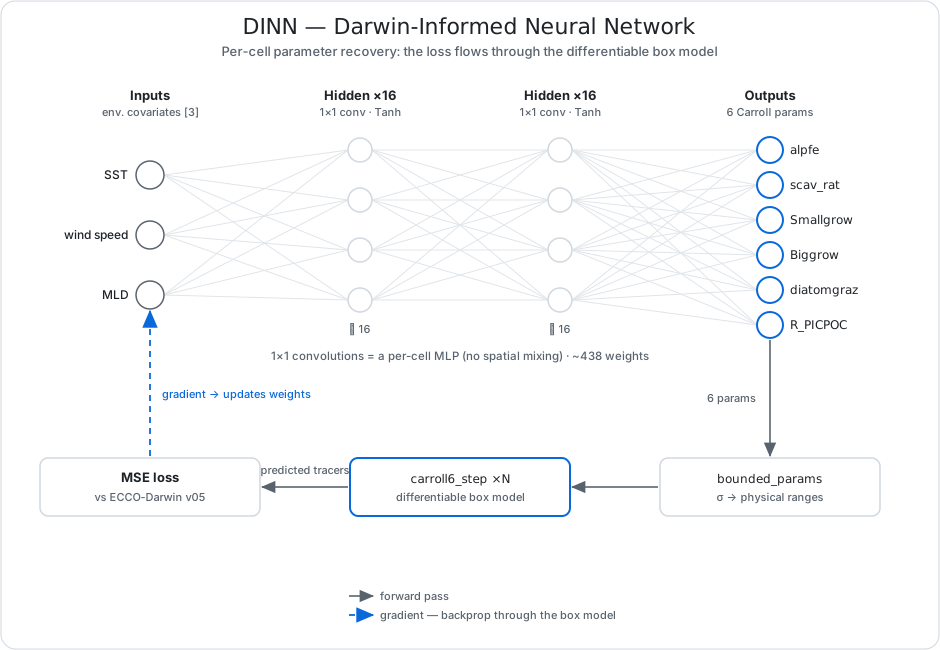
DarwinDiff is a PyTorch reimplementation of the ECCO-Darwin ocean biogeochemistry model in which gradients flow through every step of the simulation. A single loss surface learns the parameters that Carroll's Green's-functions calibration tunes one-at-a-time — predicted per grid cell from local environmental conditions. Manuscript in preparation.
This is the documentation home
The narrative docs, design notes, and per-version findings are organized in the navigation on the left. Project Status is the canonical, always-current snapshot of results. The source lives on GitHub.
Two tracks
- Parameter learner (active) — learns a per-cell function from local environment to the six Carroll parameters by gradient descent through the differentiable box model, replacing Green's-functions calibration.
- Emulator (not started) — a neural stand-in for ECCO-Darwin for long-timescale climate runs.
What works · what's blocked
This is a surrogate-to-model identifiability study — which of the six Carroll parameters are identifiable from real ocean observations. The honest target is four observable params {alpfe, scav_rat, diatomgraz, R_PICPOC}; the growth pair {Smallgrow, Biggrow} is unobservable by construction (no real data constrains growth rates).
- The iron pair (
alpfe,scav_rat) recovers reproducibly — 38/40 (95%) at the best 3-AOI config (~7 min/fit) — against real GEOTRACES IDP2025 dissolved iron. R_PICPOCrecovers against a real calcite anchor (Daniels CP:PP / MODIS PIC). The best config (geo1) holds {alpfe,scav_rat,R_PICPOC} jointly in 7/10 seeds — a 3-of-4-observable frontier (hold-together sweep, 8×n=10, allverify_runexit 0).
- No 6/6 wall.
R_PICPOCis recoverable; the differentiable Darwin calcite port + native resolution were tested and did not help — the real gap was a direct calcite observation, now supplied. diatomgrazis not recovered in the real-data sweep (best 4/10 = chance) — an iron-pair tradeoff, recoverable in principle only via dense Darwin POSi/TRAC16 (not yet staged). The growth pair is unobservable by construction.- The surrogate gap is dimensional: the 0-D box homogenizes spatial structure (tracer CV → ~1e-15), so identifiability rests on real absolute anchors. 1° proxy; 23-yr climatology; single-GPU. Full evidence → Project Status.
Documentation map
-
The canonical current-best snapshot — headline numbers, the identifiability frame (4 observable params; growth pair unobservable), and known limitations.
-
The single source of truth — what every config (v2.x box → 3-AOI
geo1→ native LLC270 → Track-2 probe) tested, found, and how each differs. -
Network architecture, the differentiable box model, the training loop, and the structural argument behind per-cell parameter recovery.
-
How the box model maps onto full ECCO-Darwin, and the parameter inventory of what is and isn't being recovered.
-
Per-version research provenance, v2.1 → v3.2 (out of the onboarding path) — the verified experimental record behind each matrix row, including the
R_PICPOCreal-calcite-anchor campaign. -
Northeastern Explorer + AICR setup, partitions, storage, and SLURM templates. See also the cluster roadmap.
-
Dataset provenance and download mechanics — ECCO-Darwin v05, GLODAP, GEOTRACES, and the shelved leapfrog sources.
Quick start
git clone https://github.com/2imi9/ECCO-DarwinDiff.git && cd ECCO-DarwinDiff
uv sync && uv run pytest -q          # smoke test
The runnable synthetic-recovery demo (~5 min, laptop / Colab T4) lives in
notebooks/demo_colab.ipynb,
and the full reproduce path is in the README.
Background reading
ECCO-Darwin (Carroll et al. 2020, JAMES; 2022, GBC) is calibrated via Green's functions (Menemenlis et al. 2005), which scale badly: each tuned parameter needs a fresh full forward run, so the published calibration handles only 6 parameters. DarwinDiff replaces the biogeochemistry side with PyTorch autograd — gradients for all parameters in one backward pass, with values varying across space. The closest method template is the per-location parameter network of Xu et al. 2025 (BINN); the full annotated reference list is in the README.
How to cite
DarwinDiff is under active development; a formal manuscript and Zenodo DOI will be issued upon publication. In the interim, cite the repository directly:
@software{darwindiff_2026,
  author    = {{ECCO-DarwinDiff contributors}},
  title     = {{ECCO-DarwinDiff}: Differentiable Ocean Biogeochemistry
               for Per-Cell Parameter Recovery},
  year      = {2026},
  publisher = {GitHub},
  url       = {https://github.com/2imi9/ECCO-DarwinDiff}
}
Released under the MIT License. The underlying ECCO-Darwin model is the work of the ECCO and Darwin teams and should be credited independently — see the citation block in the README.